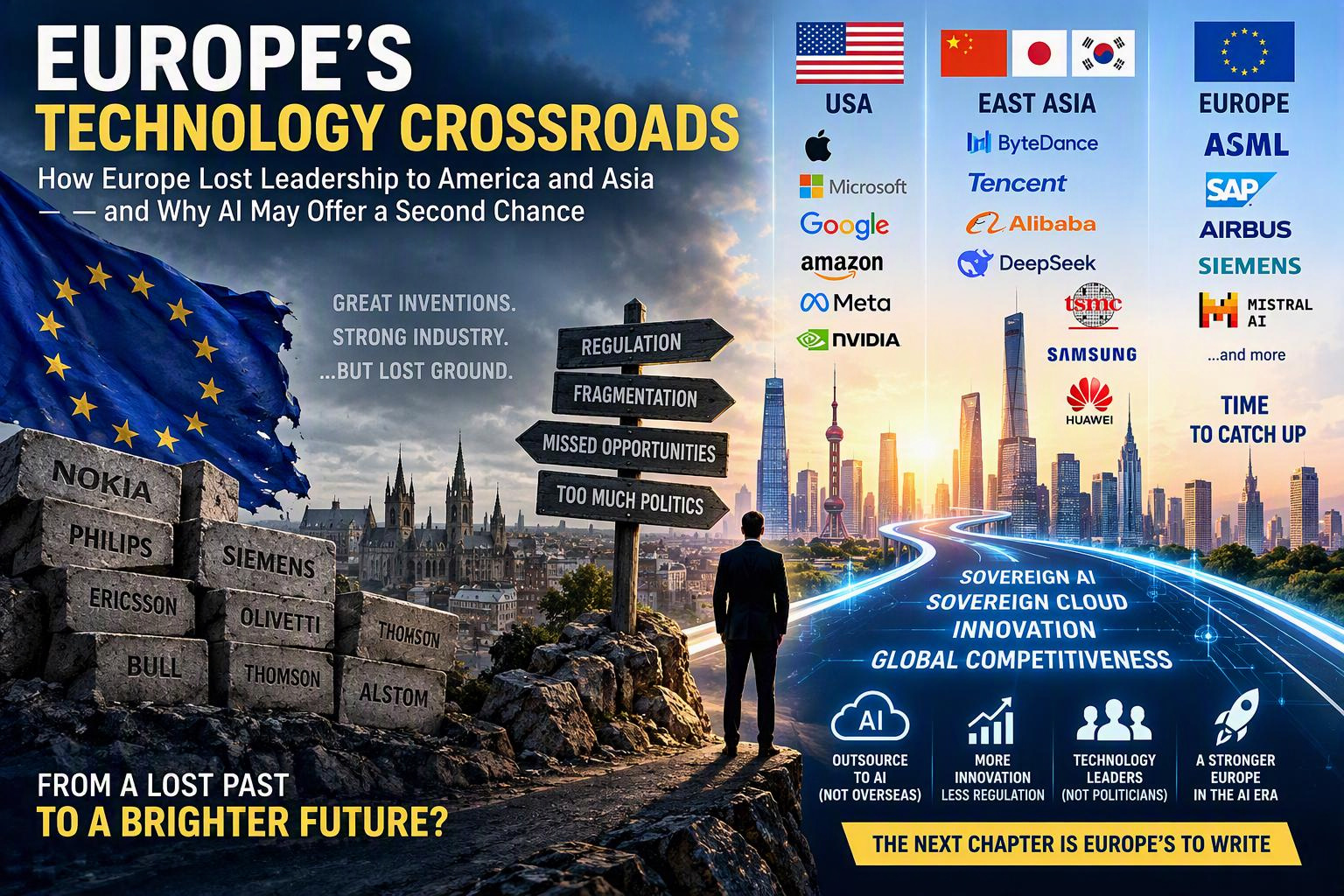

Europe’s Technology Crossroads: How Europe Lost Leadership to America and Asia
After World War II, Europe lost its dominance in global technology to the United States and East Asia across four distinct waves. Today, as emerging sectors like Artificial Intelligence, Cloud Infrastructure, and Electric Vehicles redefine global power, Europe stands at a critical crossroads.
Can European tech companies bridge the gap, or is the continent permanently relegated to being a market of consumers rather than creators? To understand where Europe can go next, we must first examine how and why it fell behind, the strategic blunders that accelerated the shift, and the exact roadmap required for a comeback.
1. The Four Waves of Europe’s Tech Transfer
The decline of European tech leadership didn’t happen overnight. It was driven by institutional fragmentation, differing capital models, and distinct paradigm shifts across four post-WWII eras.
Wave 1: The Mainframe & Early Computing Era (1950s–1970s)
While the U.S. government injected massive defense and NASA funding into commercial computer development (establishing early economies of scale), Europe relied on fragmented national champions serving small domestic markets. When IBM introduced the revolutionary System/360 in 1964, European firms could not match its budget or volume.
- European Losers: ICL (UK), Bull (France), Telefunken/Siemens Computing (Germany).
- Winners: IBM, Honeywell, Control Data Corporation (USA).
Wave 2: Consumer Electronics & Semiconductors (1970s–1990s)
East Asian economies—led by Japan, South Korea, and Taiwan—executed targeted industrial policies focused on high-yield, precision manufacturing. Japanese memory chips (DRAM) and consumer electronics undercut European and American firms alike. Meanwhile, Silicon Valley pivoted into microprocessor design and software. Europe was squeezed from both sides.
- European Losers: Philips (Netherlands), Thomson (France), Olivetti (Italy).
- Winners: Sony, Toshiba, Panasonic (Japan); Samsung, LG (South Korea); TSMC, Acer (Taiwan); Intel, AMD (USA).
Wave 3: The Mobile Telecommunications Decline (2000s–2010s)
Europe initially established a global lead in mobile connectivity through the unified GSM standard in the 1990s. However, when smartphones shifted from hardware communication devices to touch-based software platforms in 2007, European giants reacted too slowly. U.S. operating systems captured the global developer ecosystem while Asian firms scaled high-volume hardware manufacturing.
- European Losers: Nokia (Finland), Ericsson Handset Division (Sweden), Alcatel-Lucent (France).
- Winners: Apple, Google (USA); Samsung (South Korea); Huawei, Xiaomi, Oppo (China).
Wave 4: Cloud, Platforms, & AI (2010s–Present)
The modern digital economy thrives on venture capital scale, network effects, and high compute density. Fragmented European capital markets made it nearly impossible for local startups to secure late-stage growth capital, forcing them to either relocate to the U.S., get acquired, or remain niche players.
- European Outscaled: OVHcloud, Hetzner, Skype (acquired by Microsoft), DeepMind (acquired by Google), Q-Cells/SolarWorld (bankrupted by subsidized competitors).
- Winners: Amazon AWS, Microsoft Azure, Google Cloud, Nvidia, Meta, OpenAI (USA); Alibaba, Tencent, ByteDance, DeepSeek, Kimi (China).
2. Root Causes: Bureaucracy, Regulations, and Miscalculations
Europe’s tech decline was not merely caused by external competition—it was largely self-inflicted through four systemic friction points:
“Europe’s policy ecosystem has long been led by civil servants, legal theorists, and politicians rather than founders, engineers, and risk-taking venture capitalists.”
- Politicians & Bureaucrats over Business Builders: European strategy heavily prioritizes risk mitigation, societal protection, and legal compliance. While Silicon Valley celebrates rapid experimentation and failure as learning, European corporate culture severely penalizes failure.
- Preemptive Over-Regulation: Frameworks like GDPR, the Digital Markets Act, and the EU AI Act impose high regulatory compliance costs before domestic startups even achieve product-market fit. U.S. and East Asian environments prioritize rapid commercial scaling before establishing tight boundaries.
- Strategic Executive Blunders:
- Fabling Semiconductors: In the 2000s, European chip leaders (Infineon, STMicroelectronics, NXP) divested from advanced nodes, ceding logic manufacturing to TSMC and Samsung and design leadership to Nvidia and AMD.
- Nokia’s Touchscreen Dismissal: Controlling over 40% of the mobile market, Nokia management dismissed capacitive touchscreens and full OS ecosystems as power-hungry gimmicks, doubling down on Symbian until Apple and Android wiped out its market share.
- Internal Accountability: Historical European narratives often blamed foreign state subsidies or foreign monopolies. However, landmark evaluations (such as the Draghi Report) confirm that Europe’s primary bottlenecks are internal: fragmented capital markets, high energy costs, slow research commercialization, and red tape.
3. Where Europe Stands Today: The Frontier Tech Gap
In key emerging tech sectors, Europe remains severely outpaced by U.S. hyperscalers and agile Chinese tech giants:
| Sector | European Players | U.S. Champions | Chinese & East Asian Champions | Core Structural Gap |
|---|---|---|---|---|
| AI Models & LLMs | Mistral AI, Aleph Alpha, DeepL | OpenAI, Anthropic, Google, Meta | DeepSeek, Alibaba (Qwen), Moonshot (Kimi) | Severe lack of sovereign compute clusters and large-scale venture funding. |
| Cloud Infrastructure | OVHcloud, Hetzner, Scaleway | AWS, Microsoft Azure, Google Cloud | Alibaba Cloud, Tencent Cloud, Huawei Cloud | Absence of global hyper-scale data center deployment. |
| Consumer Platforms | Spotify, Just Eat Takeaway | Meta, Alphabet, Apple | ByteDance (TikTok), Tencent (WeChat), Alibaba | Fragmented market across 27 national languages and regulations. |
| AI Hardware & Chips | STMicro, NXP, Infineon, ASML (Upstream) | Nvidia, AMD, Intel | TSMC, Samsung, Huawei (Ascend) | Legacy focus on automotive/industrial nodes instead of advanced AI logic. |
4. The Path Forward: How Europe Can Catch Up
Despite these challenges, Europe has its best opportunity in decades to rebuild tech independence. The convergence of Sovereign AI, Sovereign Cloud, and AI Automation (in-sourcing via AI agents) offers a clear blueprint for domestic recovery. The Three Pillars of European Tech Independence: Sovereign AI, Sovereign Cloud, and AI Automation.
Pillar 1: Sovereign AI (Data Control & Local Models)
European enterprises in banking, healthcare, defense, and manufacturing cannot risk exporting sensitive proprietary data to foreign data centers. Local, open-weight models (like Mistral AI) running on sovereign infrastructure offer strict compliance under GDPR and local laws.
Pillar 2: Sovereign Cloud (Data Residency & Jurisdiction)
Because U.S. hyperscalers fall under the U.S. CLOUD Act, European institutions increasingly require strict data residency. Expanding local providers (OVHcloud, Hetzner) and federated edge-cloud projects allows Europe to protect sensitive governmental and industrial workloads.
Pillar 3: Outsourcing to AI (In-Sourcing Productivity)
For decades, European firms spent billions outsourcing IT, customer service, and software development to offshore regions. By deploying autonomous AI agents natively, European enterprises can shift foreign labor budgets directly into domestic software and compute licenses, keeping capital local while multiplying productivity.
Actionable Steps for European Leaders
- Empower Builders over Bureaucrats: Put tech founders, software architects, and experienced venture capitalists in charge of public innovation funds—not career politicians.
- Establish Regulatory Sandboxes: Replace preemptive restrictions with innovation sandboxes. Allow early-stage startups to iterate freely without enterprise compliance burdens until they reach scale.
- Unify European Capital Markets: Complete the European Savings and Investments Union to prevent promising scaleups from leaving for U.S. capital markets during Series B and C funding rounds.
- Leverage Core Hardware Moats: Leverage Europe’s upstream monopolies—most notably Netherlands-based ASML in EUV photolithography machines—to maintain leverage in global semiconductor supply chains.